
A thoughtful day
at Kamakhya.
A private pilgrimage day, arranged for you. With someone local at your side, you can give your visit the attention it deserves.
Guwahati hotel pickup, temple-visit coordination and care for your family, planned together before you arrive.
Plan your visitA personalised quotation after a conversation.

- Private vehicle
- An accompanying local coordinator
- Extra care for older pilgrims
Kamakhya Peeth, Nilachal Hill, Assam
Held to be the most powerful seat of the Mother Goddess.
Among the Shakta pithas, Kamakhya is the Adi Peetha, where tradition holds that Sati's yoni fell to earth. Pilgrims have climbed this hill for the Mother's blessing for as long as the texts record it, and it remains one of the living centres of Tantric practice in India.
Plan your visitYour pilgrimage, your kind of day.
Some visitors want to spend their time at Kamakhya. Others hope to visit a few more shrines. We plan the day around your wishes, available time and comfort.
We meet you at your hotel
Start from your Guwahati hotel with a private vehicle and an accompanying coordinator. We discuss the pickup and day plan with you beforehand.
Darshan arrangements, handled locally
The temple operates paid entry passes intended to shorten the wait. Our local team arranges these where they are available for your date, and coordinates your visit. Priest-assisted puja and prasad can be part of what we agree with you.
Passes and entry are subject to temple rules and availability for your chosen date.
Make room for the shrines that matter to you
Discuss Bagalamukhi, Bhuvaneshwari, Tara, Kali or other Nilachal shrines with us. We choose additions according to your interests, walking and stair needs, and the time available.
Return to your hotel
Your private vehicle brings you back to your Guwahati hotel. We arrange the pilgrimage day; we do not arrange accommodation.
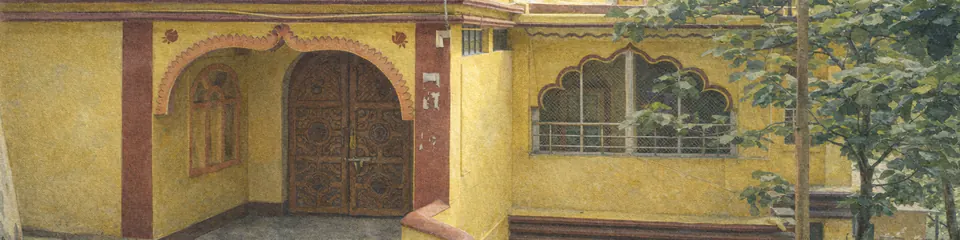
These are arrangements we can discuss, not a fixed itinerary. Your quotation will set out the agreed inclusions, separate charges and optional visits.
Ten Mahavidyas, one hill.
The main sanctum is the centre of a much larger sacred complex on Nilachal Hill. Kamakhya is the only site where temples of all ten Mahavidyas, the ten forms of the Goddess, stand together.
Kamakhya is a Shakta seat of the first rank. Tradition holds that Sati's yoni fell on this hill, which makes it her Adi Peetha, and the temple has stood at the centre of Tantric practice for as long as the texts record it. The Kalikapurana, the Yogini Tantra and the Chandi Tantra each set out the ten Mahavidyas here.
Inside the main temple the Mahavidyas are not shown as figures. They are stone symbols, often under flowers, cloth or offerings, and some sit in the caves below.
Worshipped inside the main sanctum
- KamakhyaTripura Sundari, or Sodasi. The presiding deity.
- MatangiA form of Saraswati.
- KamalaA form of Lakshmi.
With their own temples across the hill
- Kali
- Tara
- BhuvaneshwariAt the highest point, over the Brahmaputra.
- BhairaviTripura Bhairavi.
- Chinnamasta
- Dhumavati
- Bagalamukhi
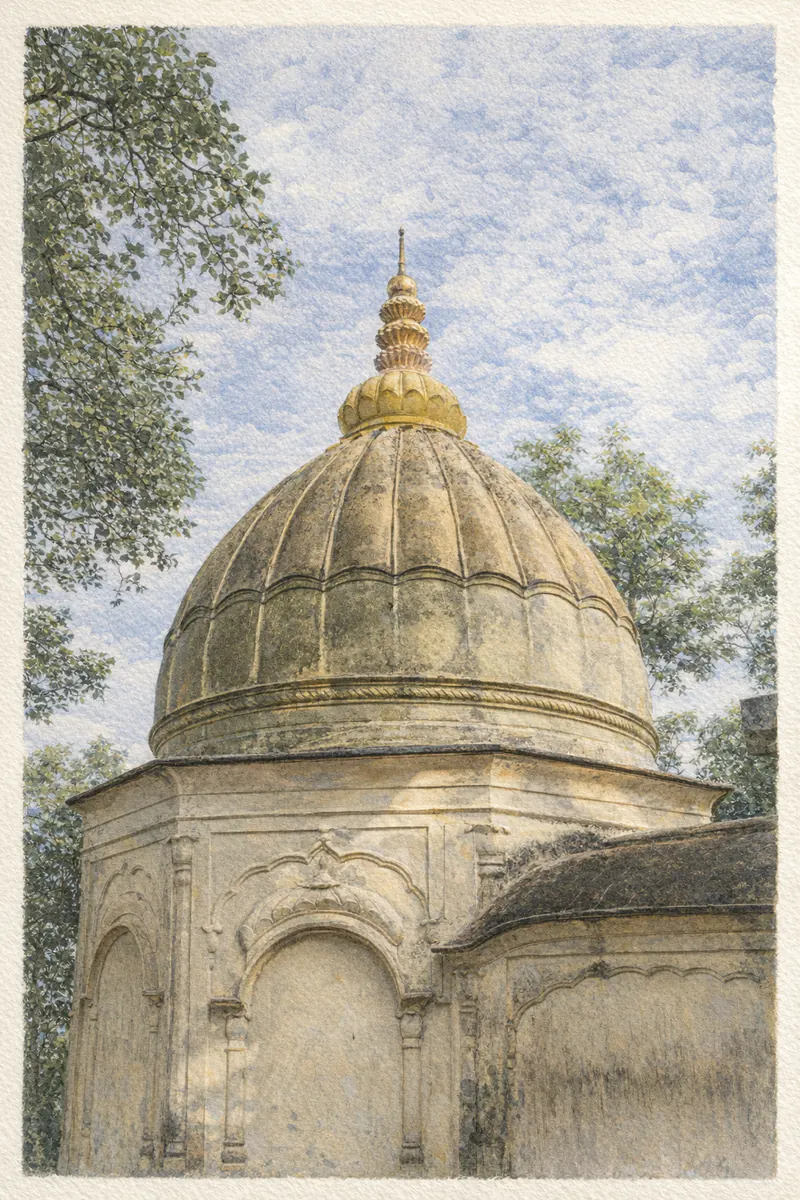
The ten, painted
Painted after Bengali, Pahari, Kangra and Nepali devotional pictures of the eighteenth and nineteenth centuries. They show how each Goddess is traditionally depicted, not the shrines themselves.
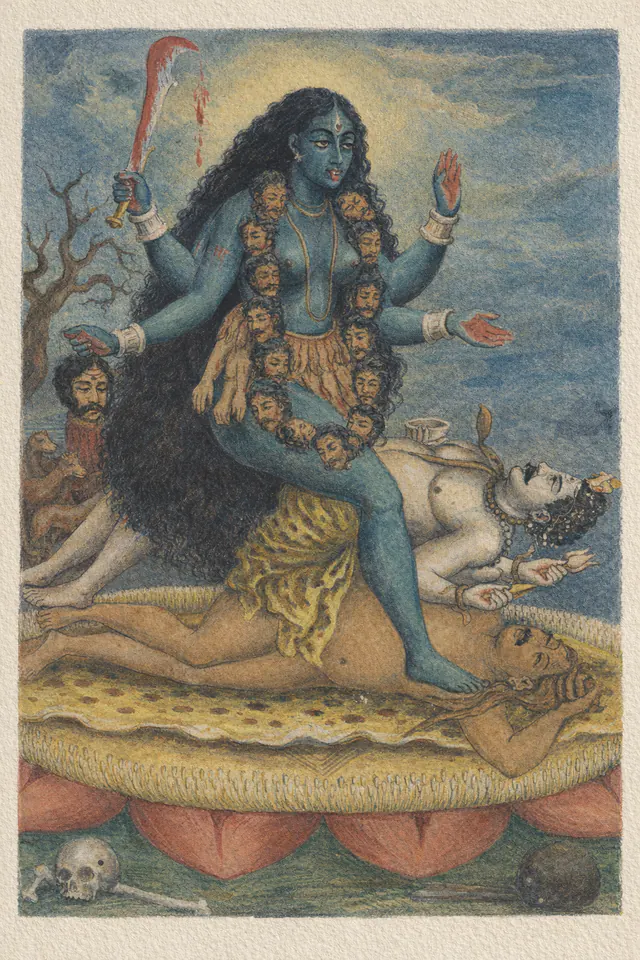
Kali
Time
Her name is the feminine of kala, time. Tradition reads her as time itself, birth and decay together, and as the release that comes from loosening your hold on both.
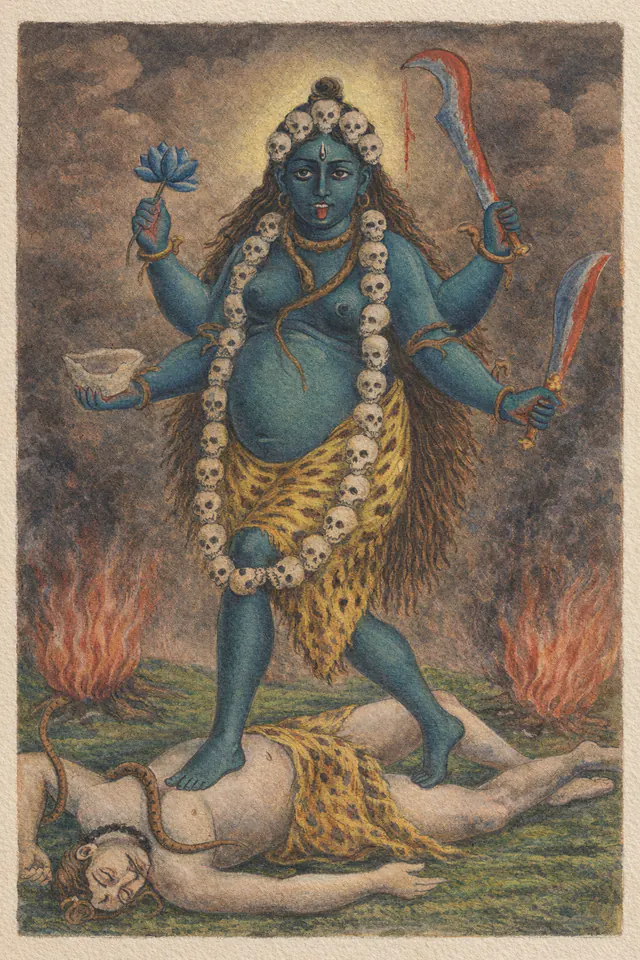
Tara
The word
Held to be Om in its feminine form, the first vibration that speech comes out of. Devotees approach her for clarity in learning and in speaking.
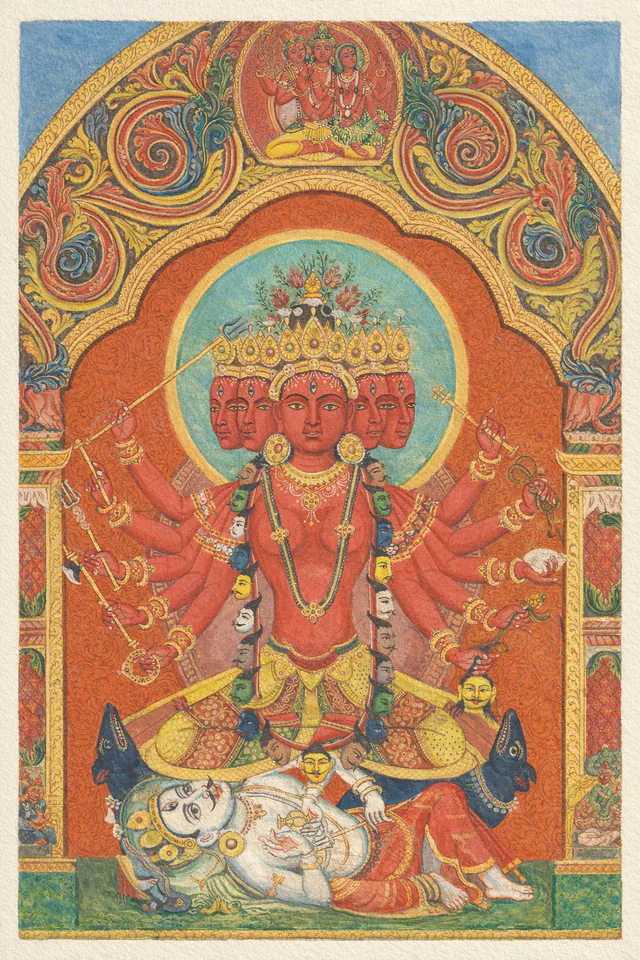
Shodashi
Beauty
The presiding deity of Kamakhya, also called Tripura Sundari and often shown as a girl of sixteen. The beauty she stands for sits in perception rather than in any object.
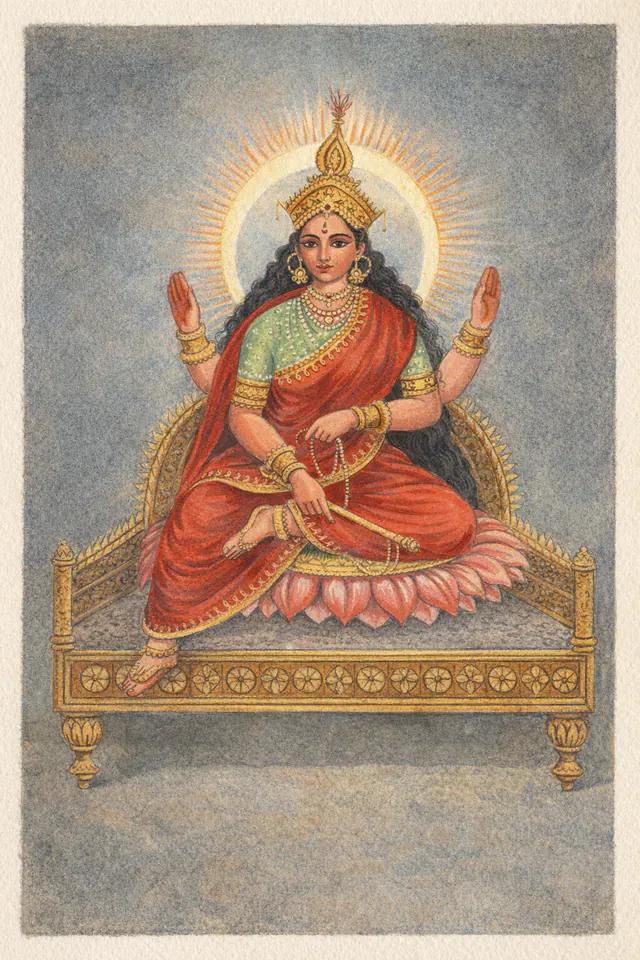
Bhuvaneshwari
Space
Her name means ruler of the worlds. The Vedas call her Aditi, the cosmic womb: the space in which everything else becomes possible.
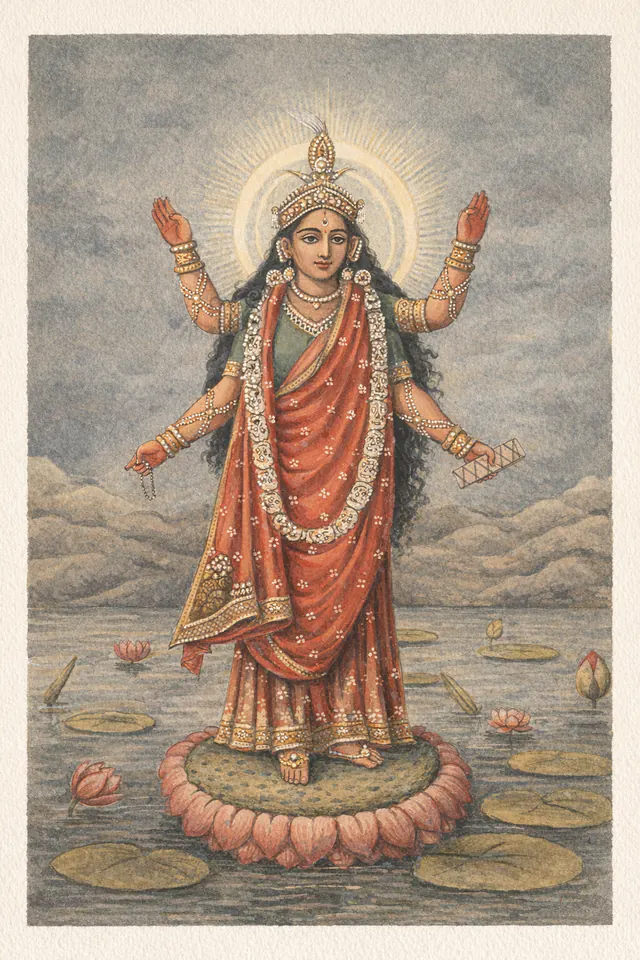
Bhairavi
Energy
The heat behind speech before it becomes words. She is approached as the flame of awareness itself, and as the power that burns through what is false.
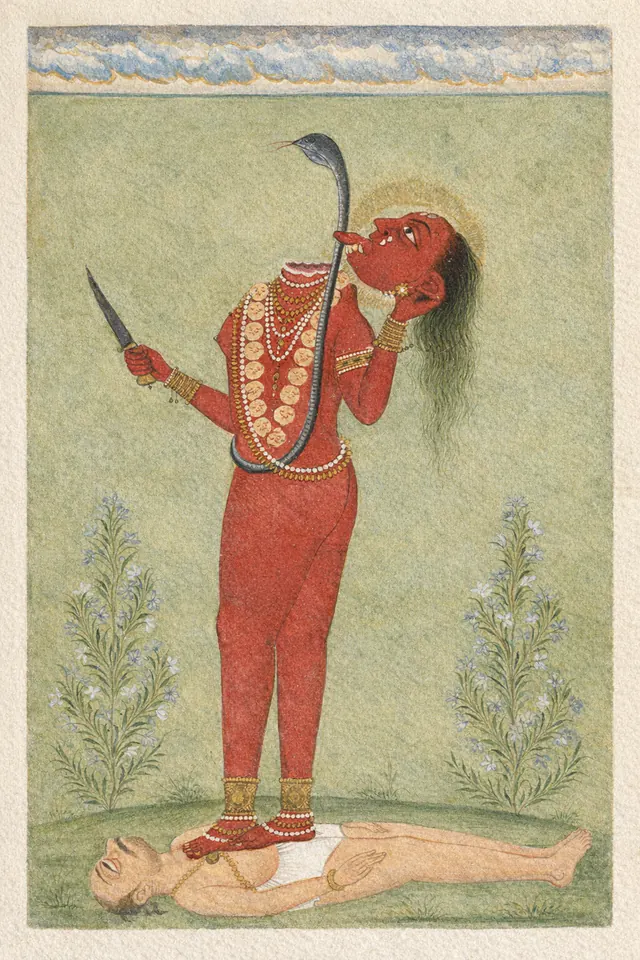
Chinnamasta
Perception
She holds her own severed head. The image is read as the mind cut away so that awareness can carry on without it.
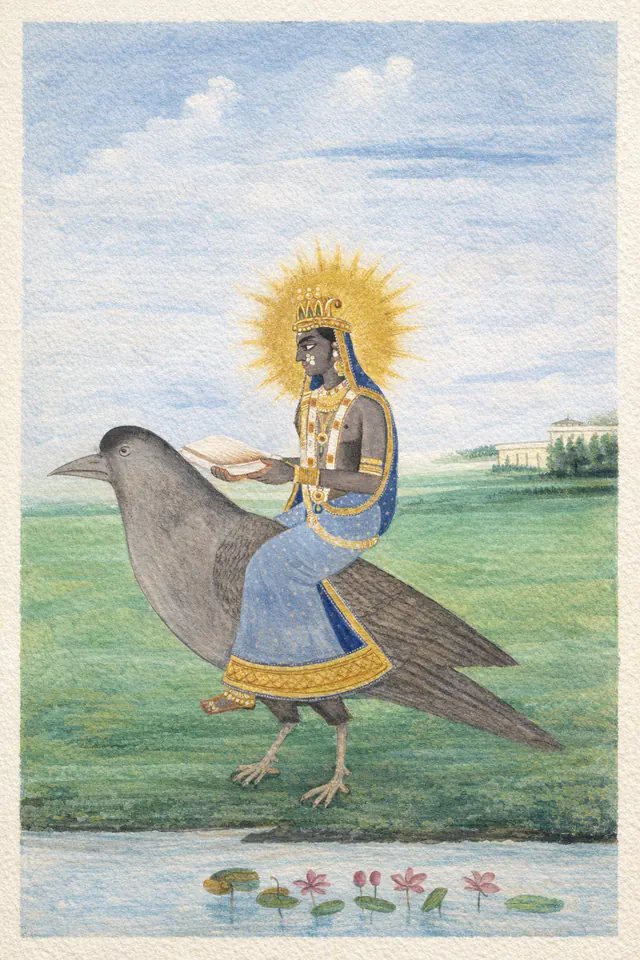
Dhumavati
Voidness
Dhuma is smoke. She is the widow form, the one who conceals rather than reveals, and who is met through loss rather than around it.
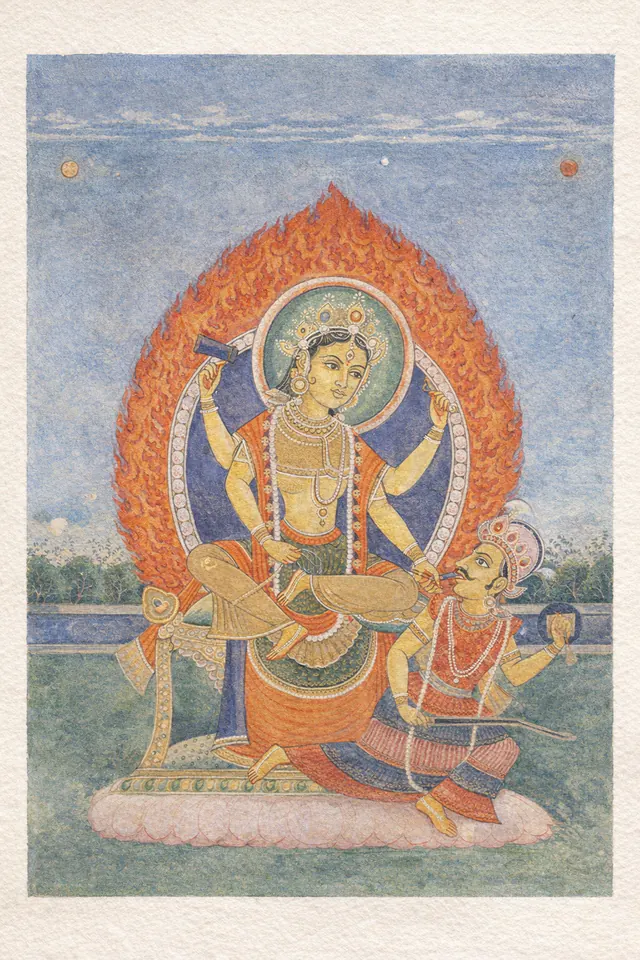
Bagalamukhi
Stillness
Her name is the bridle. She is the power that stops things, turning speech to silence and motion to rest.
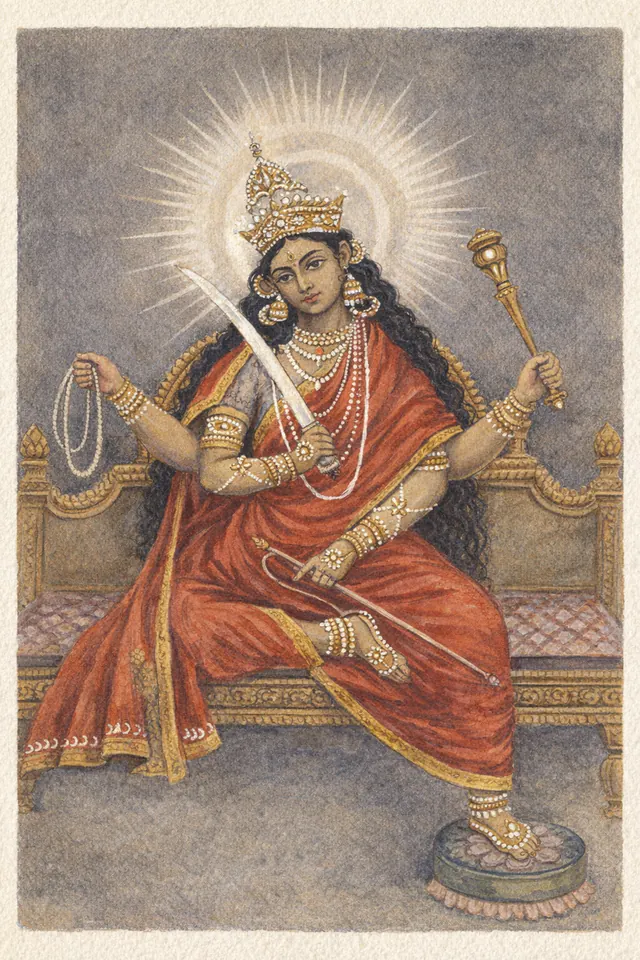
Matangi
Knowledge
The goddess of the spoken word, of learning and of the arts, identified with Saraswati. Thought becomes speech at her.
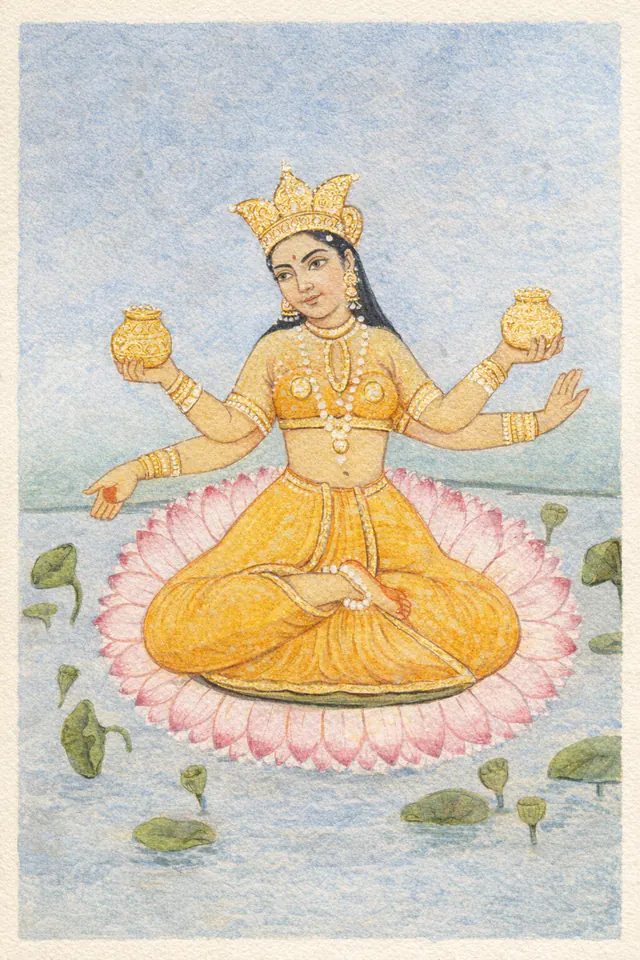
Kamala
Delight
Kamala is the lotus. She is abundance, and the eye that can find something divine in an ordinary thing.
The first five are read as the ground of things: time, the word, beauty, space and energy. The second five are read as ways of working with it: perception, voidness, stillness, knowledge and delight.
Bagalamukhi
The one people climb for.
Her temple sits apart on the south-eastern side of the hill, quieter and greener than the main approach, and it draws a particular kind of visitor. Bagalamukhi is the stiller of things. Her name is the bridle, and she is asked for the stopping of what will not stop on its own: an obstruction that has outlasted every ordinary remedy, a dispute, an opposition. Practitioners in the Tantric tradition come to her specifically.
It is a real climb, and further from the main temple than the other shrines. If someone in your party finds stairs hard, tell us and we will plan the approach and the timing around it.
Three kinds of worship
Kamakhya's own priesthood sorts its rituals into three. Knowing which is which tells you what you can watch, what falls on a date, and what you can actually ask for.
Nitya
The daily round
The temple's own worship, kept by its Shebait priests every day. The sanctum is bathed before dawn and the first puja is done before the doors open. The temple closes near midday while bhoga is offered, opens again in the afternoon, and ends with the evening aarati. You attend this rather than commission it.
Naimittika
On the day it falls
Worship tied to the calendar, again by the temple: Ambubachi, Sharadiya Durga Puja, Vasanti Puja, Ratanti Kali Puja, Pohan Bia, Durgadeul and Madandeul. These draw very large crowds, and the temple's own timings change around them.
Kamya
Asked for by a devotee
Worship the temple does not initiate. A visiting devotee offers it for a purpose of their own. This is the one we can help you arrange, and the one worth deciding on before you travel.
Who performs them
The rituals here belong to the Kulachara Tantra Marga, and a priest has to be initiated into it before he may take part. Nothing is written down. The mantras and procedures pass from guru to disciple by mouth, which is why the tradition has stayed inside the families who serve the hill.
The shrines are also linked to one another. The Kalikapurana and the Yogini Tantra hold that worship at one is not finished until the others have had their offerings, so a puja on this hill is rarely a single stop.
Ambubachi Mela falls on 22 to 26 June 2026. The temple stays closed from the 23rd to the 25th and reopens on the 26th. If your dates touch that window, tell us early, because it changes everything about the day.
A puja of your own
Devotees have long come to Kamakhya to offer a special puja to one chosen Mahavidya, each of whom is approached for something different. We can arrange this with priests who work in the Vedic and Tantric traditions, and we will tell you beforehand what the ritual involves and what it costs.
Which shrines are open on your date, and what may be offered at each, is decided by the temple.
Beyond the Mahavidyas
- Shiva
- Kameshwara within the main complex, Amratokeshwara (Tokreshwar) by the Brahmaputra, Kautilinga, Herukeswar (Muktinath), and Siddheshwara and Kedareshwara alongside the main complex.
- Vishnu
- Gadadhar Vishnu, Pandunath and Kamaleshwara.
- Ganesha
- Mahakala, the Brihad Ganesha, with four Dwarapala Ganesha shrines.
- Other shrines
- Banadurga, Joyadurga, Hanuman, Sitala, Ghantakarna and Namath Kali.
- Sacred ponds
- The kundas, among them Saubhagya, Amrita, Wrinmochana, Durga and Gaya.
Most of the Mahavidya temples are within walking distance of the path to the main temple. Bhuvaneshwari and Bagalamukhi sit further up and need a short climb or a ride. Tell us how much walking suits your family and we will suggest what fits.
Shrine timings, entry and puja arrangements differ from shrine to shrine, and are subject to temple rules on your chosen date.
Thoughtfully planned for older pilgrims.
Tell us what would make the day more comfortable. We take walking, standing and stair needs into account before suggesting a route.
Talk to us about your visit- A conversation before the visit
- We discuss your family's needs and usual mobility aids before making a plan.
- Space for a gentler pace
- We plan rest where practical and can shorten optional visits when someone needs a break.
- An extra hand with steps
- Your coordinator can help where temple rules allow it. We will explain what the route involves.
- Wheelchairs, discussed in advance
- We can arrange one on request, if the route allows it and the temple permits it.
Temple visits can involve steps, slopes and wet surfaces. Wheelchair availability does not mean every shrine is accessible. Medical care, lifting and carrying are not part of this service.
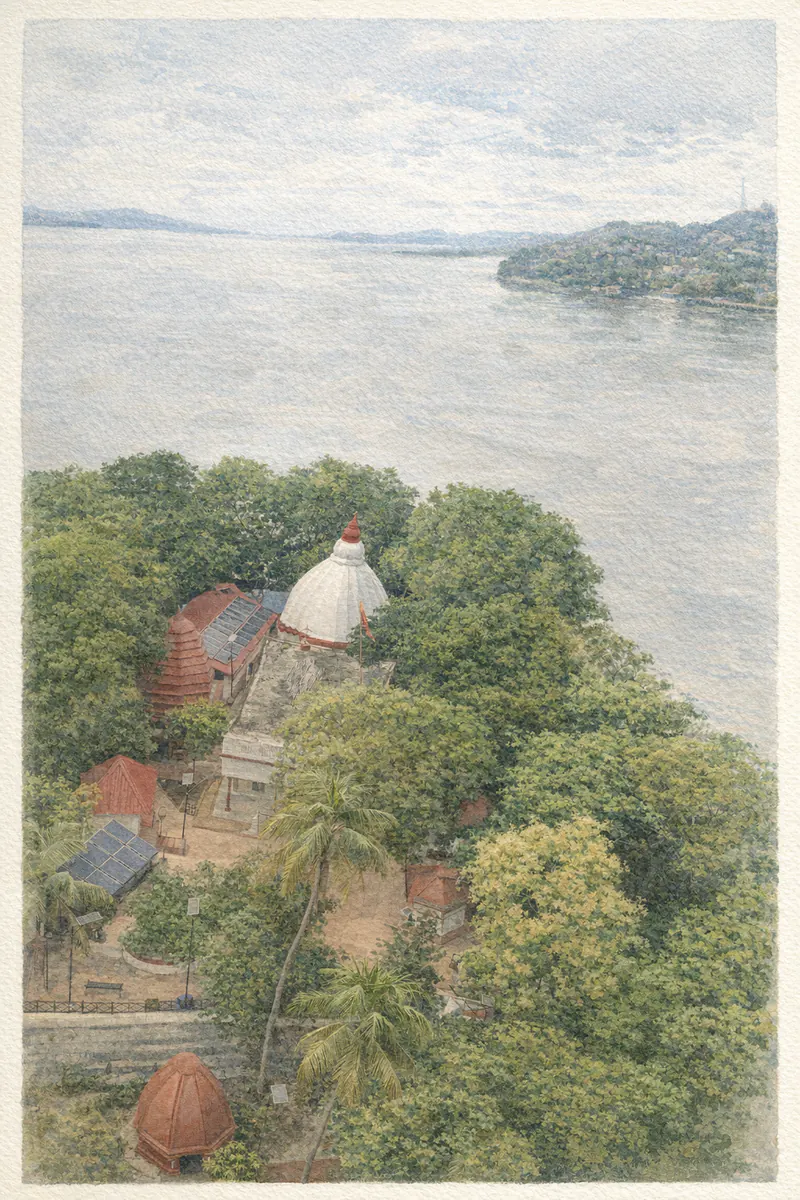
A little further, across the Brahmaputra.
If your day and your comfort allow, we can discuss a visit to Umananda, the Shiva temple on an island in the river.
This is an optional addition, with a boat crossing and steps at the island. We consider river-service availability, weather, temple access and enough time to return before including it.
Kamakhya remains the focus. You do not need a long list of stops to have a meaningful day.
Plan your visitA few things you might be wondering.
If your question is more personal, you can speak to us directly. +91 9864071827
Is this a fixed package or a shared tour?
No. Eastbound arranges a private pilgrimage day for your party. We discuss your wishes, dates and comfort before agreeing on the arrangements and quotation.
Are darshan passes or short waiting times guaranteed?
Our local team helps arrange your darshan passes and coordinates your temple visit. Passes and entry are subject to temple rules and availability for your chosen date. We do not promise a fixed waiting time or queue-free access.
Can I arrange a visit for my parents or relatives?
Yes. You can start the conversation on their behalf. We will discuss the visiting party's walking and stair needs, preferred pace and the support that is practical for the proposed route.
Can we visit Bagalamukhi and the other Nilachal temples?
We can discuss selected shrines, including Bagalamukhi, Bhuvaneshwari, Tara and Kali. Some approaches involve stairs or slopes. We build the day around your interests, mobility and the time you have. We do not promise a complete temple circuit.
What does the pilgrimage day cost?
We send you a personalised quotation once we understand what you want from the day. It sets out what the price includes, what we charge separately, such as temple or priest services and offerings, which visits are optional, and the terms for changing or cancelling. You see all of that before you commit.
Do you arrange hotels or airport pickup?
We do not arrange accommodation. Standard pickup and return cover Guwahati hotels. We do not cover the airport or anywhere outside that area as standard, so tell us if your plans need something different.
What happens after I fill out the form?
The form prepares a message and opens WhatsApp. You must review it and press Send there to contact Eastbound. Opening the link alone does not send an enquiry, and an enquiry does not confirm a visit or temple access. You can also call us.
Specialists in one pilgrimage
Eastbound is not a general tour desk. We arrange the Kamakhya pilgrimage day and very little else, from Guwahati, with our own coordinators on the hill. That is the whole of the business, which is why the day gets planned around your family rather than sold off a shelf.
We are a small, independent company. Every arrangement we describe is one we make ourselves or through the local people we work with.
Let's begin with your visit.
A few details will help us start the conversation. We can discuss the rest on WhatsApp or over a call.
Prefer to speak to someone?
+91 9864071827An enquiry starts a conversation. It does not confirm a visit or temple access.
Tell us a little about your plans
You can also message us directly +91 9864071827